Showing posts with label wikimedia. Show all posts

Monday, February 10, 2014

Louisiana State University faculty member supports student Wikipedia editing

Ambassador Becky Carmichael trains
a student during a Wikipedia workshop
If you teach in the science department at Louisiana State University and want to incorporate a Wikipedia assignment into your classroom, Becky Carmichael is the person to meet. She began volunteering as a Wikipedia Ambassador in the Wikipedia Education Program in the United States in 2011, during her graduate studies and work as a teaching assistant for a Conservation Biology course. Since she had taught the class many times and was familiar with the content, she said it was a great way to focus on “the nuances of Wikipedia.” Then Becky became the Science Coordinator with Communication across the Curriculum, a Louisiana State University program that helps undergraduates improve their writing and technological communication skills. She already understood the basics of editing Wikipedia and how to incorporate it into a classroom assignment, and now she could reach instructors in other areas of science.
To date, Becky has helped 13 classes use Wikipedia as a teaching tool. With so much experience as a Wikipedia Ambassador, she has developed her own training routine and learned the importance of communicating these assignments’ potential impact.
“For students, I like to introduce Wikipedia with a pre-workshop homework set,” she says. “The homework is very similar to the Wikipedia Ambassador training I received in 2010, with the addition of the online “training for students” — a truly valuable resource! During the workshop, we can get into details about what Wikipedia is, the importance of sharing information, and what they will gain from the experience. I emphasize that as members of the university, we have access to a wealth of information and resources the general public may not. We can give our research and exploration of a topic purpose by sharing with others.”
When instructors work with Becky to develop Wikipedia assignments, they get advice from someone who teaches with Wikipedia herself.
“I teach an honors-level course for non-science majors, Natural Disturbances and Society,” Becky says. “This is a course I developed to examine how natural disturbances (e.g., fires, hurricanes, invasive species) influence our lives and how society can influence disturbance events. My class is currently proposing creation of articles or the significant contribution to existing pages related to the course. It’s a great class, which encourages science literacy and exploration, with interesting connections to society, which may currently not be included in some disturbance or disaster articles.”
In Becky’s experience, in the beginning of the term, “students are initially uncomfortable with contributing to Wikipedia. They think it will break and become intimidated because of the global visibility. And who wouldn’t be nervous? Their work is going to be read by potentially millions of people, not just their instructor. I tackle this by having the students provide each other feedback on drafts in their sandboxes first. It is still intimidating to let classmates review their work, but I found that the students really put forth even better initial drafts. They also help each other learn better communication skills, sharing editing tricks and grammatical advice. It’s amazing how much the quality of contributions improved. The feedback exercise was also one of the aspects students really found useful stating they appreciated learning how to clarify and strengthen their writing.”
One of the great things about partnering with a university professional is that her Wikipedia Ambassador responsibilities fit so neatly into her job description.
“My focus as the Science Coordinator is to aid undergraduates in effectively disseminating scientific information through writing, speaking, visual, and technological means. Additionally, I assist faculty in course and assignment design that improves communication and critical analysis skills. Wikipedia can be the perfect way to achieve both of these skill sets because it is a cooperative writing process based in technology,” Becky says.
Her work as a Wikipedia Ambassador advances her mission within her career, and her role at the university gives her a great opportunity to influence students. By providing “one-on-one assistance to both faculty and students learning how to edit and navigate the site,” Becky makes sure assignments will not only achieve important learning objectives but also will positively impact Wikipedia.
As Becky has become a campus expert in teaching with Wikipedia, she has welcomed the opportunity to reach course goals creatively.
“I enjoy brainstorming ways to approach an assignment, make connections to real-world applications, and methods to excite the students,” Becky says. “I am passionate about improving science literacy and can truly ‘geek out’ over science topics. I like that Wikipedia represents sharing of knowledge and the increase of literacy in many topics in a friendly environment. The community involvement can be impactful on both student learning as well as inspiration for continual discovery.”
Jami Mathewson
Program Manager, Wiki Education Foundation
__________________________

Originally posted by Jami Mathewson on February 10, 2014; text is released under a CC by 3.0 license (see original source).

Sunday, January 19, 2014

Announcing Wikimedia’s New Community-Centered Trademark Policy

The Wikimedia sites are built by a community of volunteers. Today, we finalized a new trademark policy that is specifically tailored to the innovative events and outreach that Wikimedia volunteers conduct to build sites like Wikipedia and its sister projects. The policy was developed through a seven month long consultation with our community of users. It received almost 550 comments and over 340 changes to the policy (you can actually see all changes to the draft in the wiki revision history).
Together, we created a policy that will empower the collaborative community that makes the Wikimedia sites thrive. Focusing on the community, the new policy is unconventional in how it provides expansive use of the Wikimedia marks while maintaining legal protection. It was designed to be clear and easy to understand, with the help of an information design workshop at Stanford Institute of Design. The result of our work is released under a Creative Commons license, so feel free to build on it when designing a policy for your own trademarks. (Just make sure to change the trademarks in the policy!)
The new policy makes it easier for community members to use the marks in the following ways:
    • New uses of marks without requesting a license: The new policy contains an intuitive summary listing the many ways community members may use Wikimedia marks without a separate license. It allows community members to use the marks on all Wikimedia sites and even outside the sites to facilitate common activities that advance our mission.
    • Clearer explanation of fair use: Our consultations revealed confusion over how to use Wikimedia marks under fair use and whether US fair use laws would apply in countries that do not recognize the same fair use rights. The policy now clearly describes many examples of how Wikimedia marks may be used in, for example, news reporting without additional permission, regardless of where the user resides.
    • Streamlined licensing procedures: We are introducing a “Quick license,” which grants community members the ability to quickly start using Wikimedia marks for a photo contest or GLAM event after emailing it to us. No need to wait for approval! Quick licenses are easy to read. They include only the most essential provisions, with a brief explanatory key of each provision.
  • Straightforward language: Unlike the policies of many other companies, our new policy uses simple words, short sentences, and straightforward sentence structure to make it easier to follow. We recognize that some readers of the policy may not be native-English speakers, so we avoided using legalese to ensure easy translation into multiple languages. To verify the simplicity of the language, we applied various readability indices and rewrote text flagged as difficult until it had a better readability score.
  • User-friendly layout: After considering cutting-edge information design principles, we used icons, color coding, typography, and white space to make the policy both visually appealing and easily accessible. Many community members approved of the design, and felt that, “it’s very approachable and easy to read.” We also included a color-coded summary to provide a brief overview of how to appropriately use the Wikimedia marks.
  • Many helpful Frequently Asked Questions: The new FAQ section includes answers to 86 questions, compared to a mere 24 in the 2009 policy. The FAQs are based on issues that commonly arise in our trademark licensing process and questions raised during the policy discussions. In addition, the FAQs are grouped in categories that mirror the trademark policy provisions and are interlinked with relevant provisions to allow easy navigation between the two documents.
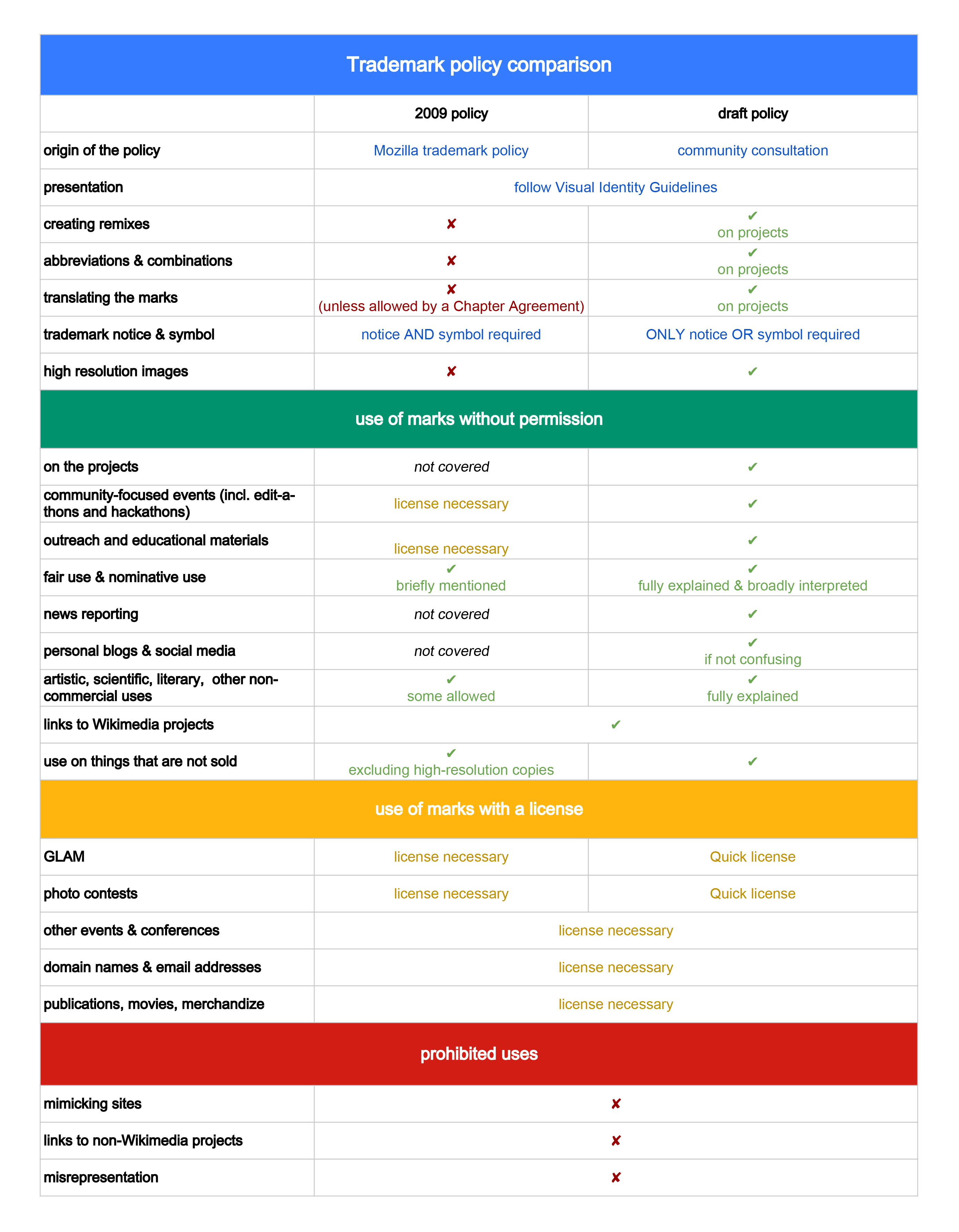
The new policy will now be presented for review to the Wikimedia Board of Trustees. If approved, it will replace the existing policy from 2009. The old policy became outdated with the rapid expansion of the Wikimedia projects that introduced new and unanticipated uses for the Wikimedia marks. A table at the end of this blog post shows how the new policy compares to the 2009 policy.
The development of this innovative policy could not have been possible without the hard work and dedication of the Wikimedia community. With their collaborative input, we were able to expand and clarify provisions of the policy to better serve the needs of community members in their work to promote and improve Wikimedia projects. The permissive use of marks is unmatched by the policies of other websites. We sincerely thank community members who participated in the policy discussion for once again making Wikimedia innovators of the online world.

Yana Welinder, Legal Counsel *
Geoff Brigham, General Counsel

* Many thanks to Stephen LaPorte and Manprit Brar for all their work with this blog post and the trademark policy generally. We would also like to thank everyone at WMF who worked hard to make the new policy possible.


_______________________________

Original source: http://blog.wikimedia.org/2014/01/19/announcing-wikimedias-new-community-centered-trademark-policy/ under a CC BY 3.0 license.
"Trademark-table-01-2014" by Wikimedia Foundation - Yana Welinder, under CC-BY-SA 3.0 Unported, from Wikimedia Commons